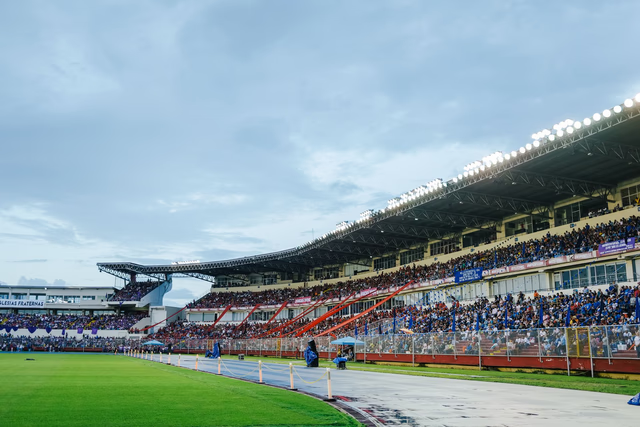
Germany Won 7-1 But Curaçao Made History
Winning Score Team Published Tue 16 Jun Updated Tue 16 Jun

The scoreline says 7-1.
But the goal that will be remembered is not one of the six on the winning side.
It is the single goal of the side that lost.
In the 21st minute, Livano Comenencia struck past 40-year-old Manuel Neuer — Curaçao’s first ever goal at a World Cup.
A win is measured in the scoreline. History is measured by the first moment.
The short version (20 seconds)
- Germany hammered Curaçao 7-1 in their Group E opener in Houston on 14 June 2026
- Comenencia scored in the 21st minute past 40-year-old Neuer — Curaçao’s first ever World Cup goal
- Curaçao are the smallest nation in World Cup history, around 156,000 people
- Havertz scored twice, not a hat-trick — Germany’s third seven-goal finals rout this century
- The two dugouts were 39 years apart — Advocaat, 78 (oldest in World Cup history) and Nagelsmann, 38
The scoring machine called Germany
Germany arrived on a nine-match winning run, and they kept the engine running.
Eight goals came in one match, seven of them German, shared across the team.
| Scorer | Minute (FIFA) |
|---|---|
| Felix Nmecha (Germany) | 6’ |
| Livano Comenencia (Curaçao) | 21’ |
| Nico Schlotterbeck (Germany) | 38’ |
| Kai Havertz (Germany, pen) | 45+5’ |
| Jamal Musiala (Germany) | 47’ |
| Nathaniel Brown (Germany) | 68’ |
| Deniz Undav (Germany) | 78’ |
| Kai Havertz (Germany) | 88’ |
Havertz scored twice, not the hat-trick some rushed to claim (FIFA). Substitute Deniz Undav added a goal and two assists, while Joshua Kimmich provided two more.
The more striking number is the historical context. Since 2000, only five World Cup finals matches have seen one team score seven or more, and three of those five are Germany (Nigeria Info / Reuters).
| Year | Stage | Winner | Score | Opponent |
|---|---|---|---|---|
| 2002 | Group stage | Germany | 8-0 | Saudi Arabia |
| 2010 | Group stage | Portugal | 7-0 | North Korea |
| 2014 | Semi-final | Germany | 7-1 | Brazil |
| 2022 | Group stage | Spain | 7-0 | Costa Rica |
| 2026 | Group stage | Germany | 7-1 | Curaçao |
This 7-1 echoes the legendary 2014 result, when Germany beat hosts Brazil by the exact same score.

The goal bigger than the scoreline
Amid Germany’s seven, the goal that brought the stadium to its feet belonged to the side that was losing.
In the 21st minute, Livano Comenencia, a 22-year-old right-back pushed into an attacking midfield role, struck with his left foot from the centre of the box. The ball took a slight deflection before beating Neuer (FIFA).
And Neuer did not fumble it — he was beaten from open play. Born on 27 March 1986, Neuer was 40 years and 79 days old on matchday, the oldest German player ever to feature at a major tournament.
The strike is officially logged as Curaçao’s first ever goal at a World Cup finals. Their previous finals record was zero games, zero goals, zero conceded — because they had never reached this stage at all.
A 7-1 defeat, and yet in Curaçao’s record book this page opens with the words “first goal.”
The smallest nation the World Cup has seen
Curaçao is a Caribbean island of around 156,000 to 160,000 people.
That makes them the smallest nation ever to reach a World Cup, breaking the record Iceland (around 350,000) set in 2018 (Flashscore).
Behind that arrival is a clever strategy — 25 of the 26-man squad were born in the Netherlands and chose to play for Curaçao through family heritage. A tiny nation that built a World Cup team out of its diaspora.
So one goal from a nation of 160,000 is not just a statistic. It is the validation of a whole generation’s journey across an ocean.

A 39-year gap on the touchline
The second story in one game played out on the two benches.
For Curaçao there was Dick Advocaat, the Dutch coach born on 27 September 1947. On matchday he was 78, and FIFA confirms him as the oldest manager in World Cup history (FIFA).
For Germany there was Julian Nagelsmann, 38, one of the youngest coaches of the tournament.
The distance between the two dugouts was around 39 years — almost the length of an entire career.
Advocaat has coached for 45 years across 28 clubs and national teams, from PSV Eindhoven, Rangers and Sunderland to Zenit, and once took the Netherlands to the 1994 quarter-finals. Curaçao is his eighth national team (LiveMint).
A near 40-year age gap turned into a 7-1 result on the pitch. But it is also a picture of a game with room for every generation on the same stage.
Beaten seven times, richer by one moment money can’t buy
One game does not decide a tournament, and a 7-1 makes clear the gap between giant and newcomer is still wide.
But what this game leaves behind is not the size of the scoreline. It is the 21st minute, when an island in the middle of the ocean saw its own name on a World Cup scoreboard for the first time.
Germany move on as favourites. Curaçao go home with a painful scoreline — and a goal money cannot buy.
Follow Group E’s fixtures and rivals on the 2026 World Cup groups page, and read the full story of Curaçao, the smallest nation at the World Cup, who came further than anyone expected.
Sources
- Germany 7-1 Curaçao — official match report and highlights (scorers and minutes) — FIFA, 2026
- Comenencia's Curaçao dream comes true — their first ever World Cup goal — FIFA, 2026
- Advocaat vs Nagelsmann: different eras, one touchline (oldest and youngest coach) — FIFA, 2026
- Germany set a World Cup record with a third seven-goal rout this century — Nigeria Info / Reuters, 2026
- Curaçao script history before Germany's seven-goal blitz — Times of India, 2026
- Who is Dick Advocaat, the oldest manager in World Cup history, 45 years of coaching — LiveMint, 2026
- Curaçao, the smallest nation in World Cup history, take on giants Germany — Flashscore, 2026
FAQ
- What was the score in Germany vs Curaçao at the 2026 World Cup?
- Germany won 7-1 in their Group E opener on 14 June 2026 in Houston. Germany's scorers were Nmecha, Schlotterbeck, Havertz (2), Musiala, Brown and Undav, with Comenencia scoring for Curaçao (as of 14 June 2026).
- Did Havertz score a hat-trick against Curaçao?
- No. Havertz scored twice — a first-half stoppage-time penalty and an 88th-minute open-play goal — not a hat-trick, per FIFA's official report.
- Why did Curaçao's goal matter?
- Livano Comenencia scored in the 21st minute past 40-year-old Manuel Neuer. It was Curaçao's first ever goal at a World Cup finals — they had never played at a finals before.
- Why was the coaching matchup special?
- Curaçao's Dick Advocaat, 78, is the oldest manager in World Cup history according to FIFA, while Germany's Julian Nagelsmann is 38 — a gap of around 39 years.
- What kind of nation is Curaçao?
- A Caribbean island of around 156,000 to 160,000 people, the smallest ever to reach a World Cup, beating Iceland's record. 25 of the 26-man squad were born in the Netherlands and qualify through heritage.