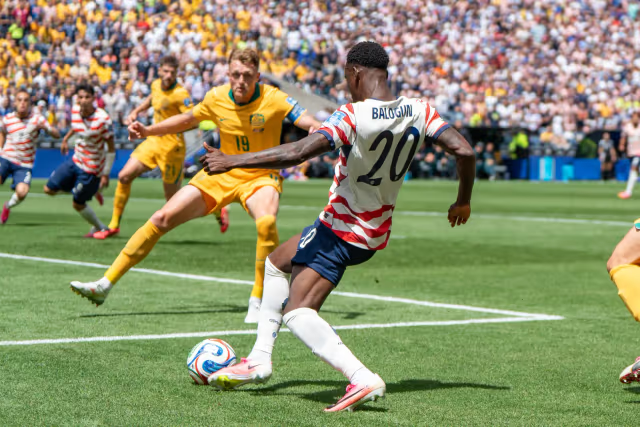
Norway vs England QF — The Ghost of 1981
Winning Score Team Published Wed 8 Jul Updated Wed 8 Jul
Oslo, 9 September 1981. The signal from NRK radio distorts because the commentator is screaming himself hoarse.
Bjørge Lillelien has just watched Norway — a side with only five professionals, the rest amateurs who play after work — beat Bryan Robson’s England 2-1 on home soil. So he reads out a roll-call of English heroes, one by one, from Lord Nelson to Churchill to Lady Diana, and finishes with the line that outlived them all: “Your boys took a hell of a beating!” (Aftenposten)
Forty-five years later, the same two nations stand across from each other again — this time in a real World Cup quarter-final, not a qualifier, at Hard Rock Stadium in Miami.
But the roles have flipped.
In 1981, Norway were the David who toppled Goliath. In 2026, Norway are the Goliath — his name is Erling Haaland, the most clinical striker in the world, a man born in England, paid by an English club, who has just dumped Brazil out of the tournament with two goals of his own.
- Market probabilities on the match page: Norway 24% · Draw 26% · England 51% (as of 6 Jul 2026)
- Norway beat Brazil while losing the chances battle; England are unbeaten but survived Mexico on 33% possession
- Both won ugly. The number leans England — but it weighs a whole game, not one dead-ball moment
- The quiet swing factor: Haaland at a set piece in a one-off knockout, plus a 33°C Miami furnace that punishes the team doing the chasing
Beat Brazil — and still the underdog
Fresh off knocking out Brazil, Norway are still only a 24% shot. First, be honest about that number: it is not a Winning Score model.
The World Cup has no season-long statistical model behind it the way a league does. So the figure on the match page is pure market — the consensus of money, mapped transparently into percentages (Norway vs England match page).
So what is the market reading to keep Norway this far back?
It reads history. England arrive in the last eight unbeaten across five games, four wins and a draw, with a full deck of names. Norway are back at a World Cup for the first time in 28 years and were beaten 1-4 by France along the way. It reads style, too: Norway chase games more than they lead them — even against Brazil, they didn’t score until the 79th minute.
The market weighs the whole match. It does not weigh what one man can do in three seconds. That is the crack worth prising open.
Norway won ugly. But they won.
Glance at the Brazil numbers and you’d struggle to say who lost. Norway had 66% of the ball and 679 passes to Brazil’s 330. That looks like the better team.
Expected goals tells the opposite story. Brazil generated 2.61 xG to Norway’s 1.05, with more shots and the sharper chances (xG Score). Norway didn’t win by playing better. They won because Ørjan Nyland, their 35-year-old keeper, guessed right and saved Bruno Guimarães’ 13th-minute penalty, and then Haaland headed and drilled in two late goals (Sky Sports).
USA Today put Norway’s plan in the fewest words possible — “control the ball as much as possible for as long as possible, and feed the big man in the middle” (USA Today). This is a team that knows it isn’t the better side, so it sits, waits, and banks on one second from the best player on the pitch.
Hold that image, because it’s the exact template Norway will bring to England.
The boy born in England, back to knock England out
Of every name on the pitch, none is bound to England more tightly than the one Norway will feed.
Erling Haaland was born in Leeds, England, on 21 July 2000, while his father Alfie was at Leeds United. As a boy he had a Leeds kit in the wardrobe. Today he plays for Manchester City (NDTV).
But the heavier thread is his father’s. Alfie Haaland spent a decade in England — Nottingham Forest, Leeds, then City — and his career ended with a scar. In April 2001, in a Manchester derby, Roy Keane launched a deliberate studs-up challenge at him, four years after Keane decided Alfie had mocked him over an injury. Keane later admitted the intent in his own autobiography. Alfie’s verdict, years on: “For eight years, I wasn’t injured. Coincidence or not, that was my last 90 minutes in England.” (OneFootball)
That man’s son now lines up against England — with numbers his father never came close to.
Haaland has 7 goals in four games. His conversion rate is 39% (7 from 18 shots) — the best by any player with 15-plus attempts at a single World Cup since Gary Lineker in 1986. And the figure England should fear most is in the air: he wins 78% of his aerial duels, and against Brazil he headed in over Gabriel, rated one of the Premier League’s best aerial defenders (ESPN).
Unbeaten, but wobbling
England walk into the last eight unbeaten. Their last game is the warning.
In the round of 16 at the Azteca, England beat Mexico 3-2 — but on just 33.2% possession, their lowest in a World Cup match since 1966. They made 48 clearances, faced 49 crosses, and finished with ten men after Jarell Quansah’s red. Jude Bellingham scored twice in 98 seconds to lead 2-0 before Mexico clawed it back to 3-2 (ESPN). This is a side that won ugly, too.
And the problem that lines up exactly with this fixture is right-back. Tino Livramento was out before the tournament, Reece James has a hamstring and is “touch and go,” Quansah — who filled in at right-back — is suspended, and Jordan Henderson broke his wrist celebrating the Mexico win, falling over an advertising board (Sky Sports). Thomas Tuchel has Norway winger Antonio Nusa waiting on that flank — England’s most fragile position.
Up top, England still bite. Harry Kane is already the country’s all-time World Cup top scorer, and Bellingham is red-hot — but several England players, Bellingham included, are one booking from a ban, and a second yellow tonight means missing the semi-final (The Independent). Tuchel has talked from day one about a “second star” on the shirt and called the Mexico win a night that “feels like winning a final” (The Guardian). Sixty years of waiting sit on these players every time out.

The duel that decides it: Haaland vs the City centre-backs
This game has a one-on-one the whole stadium knows will settle it — Haaland against England’s defence — and the twist is that several of those defenders know him too well.
John Stones, Haaland’s former City team-mate, says England are “fired up” to knock his old friend out (Evening Standard). The Telegraph even floated the idea of England fielding three City players — Guehi, Konsa, O’Reilly — to mark him, on the logic that the men who train with Haaland every day know his movement best (The Telegraph).
But inside knowledge cuts both ways. Yes, they train with Haaland. Haaland also trains with them — he knows where England’s defenders stand, which way their heads turn when the ball comes in from the corner, and he knows not one of them is a natural aerial specialist.
That is the gap the goals model can’t see through.
Where the model might miss: set pieces and the Miami furnace
Here is the part to say plainly. A model built on xG captures “Haaland in open play” — his conversion, his touches, his chance quality. What it can’t fully price is Haaland at a dead ball in a single knockout game.
Norway have banked 1.7 set-piece xG this tournament — one of the highest figures going — a number that reflects the danger from corners and free-kicks with a 6’5” striker in the box (FotMob). His first goal against Brazil came from exactly that, and the Mexico game just proved England can be squeezed into a deep block and bombarded — 49 crosses faced.
Picture it 0-0 at the 75th minute. Norway swing a Martin Ødegaard delivery to the back post for Haaland’s run. That is the single likeliest moment to decide the game — and it’s a human, spatial, split-second threat, not an average a model computes cleanly.
Layer the sky on top. Miami on Saturday is forecast around 33°C, humid, with a real chance of afternoon thunderstorms — England’s Mexico game was already delayed by lightning (Evening Standard). Heat like that doesn’t help the team that has to chase and press for 90 minutes. It helps the team that sits, saves its legs, and waits for one moment — which happens to be Norway’s exact game.
And don’t forget Ståle Solbakken’s spare card. Andreas Schjelderup came off the bench against Brazil and set up both Haaland goals. If this stretches late, a player like that on the bench is a variable the number never prices right.
So who takes the beating tonight?
This isn’t a game about who has more stars. It’s about whether England’s quality across 90 minutes controls Norway before Norway can drag the match down to the one dead-ball moment they’re built for.
Three questions to weigh before the 4 a.m. kickoff.
Can England patch up a right-back position that has collapsed as a unit, against Norway’s width and aerial threat?
If the game tightens into a set-piece decider, who holds the better hand — the team with Haaland lurking at the back post, or a back line with no natural aerial specialist?
And will 33°C in Miami drain the pressing side and slow the game into exactly the territory Norway prefer?
If you back England’s depth and quality — unbeaten all tournament — lean one way. If you back Norway’s set pieces, Haaland, and the knockout nerve of a side that just took down Brazil, lean the other. The number has picked its side. Which one you trust is your call.
See every outcome and the latest numbers on the Norway vs England match page, trace the full knockout path on the World Cup 2026 bracket, revisit the night Norway beat Brazil in our Brazil vs Norway review, and read the other quarter-final in our France vs Morocco preview.
Sources
- «Your boys took a hell of a beating» — Lillelien's 1981 commentary, 30th-anniversary transcript — Aftenposten, 2013
- Norway vs England — full head-to-head record — eu-football.info
- Brazil 1-2 Norway — Haaland's late double, Nyland's penalty save — Sky Sports, 2026
- World Cup 2026 stats — Haaland's 7 outscores Messi and Mbappé — ESPN, 2026
- Alf-Inge Haaland, Erling's father — his English career and the Roy Keane tackle — NDTV Sports, 2026
- England sweat on Reece James — Quansah suspended, Henderson out — Sky Sports, 2026
- Five England players one booking from missing a semi-final — The Independent, 2026
- Stones relishing the Haaland battle against his former City team-mate — Evening Standard, 2026
- Norway's 1.7 set-piece xG — the aerial weapon built around Haaland — FotMob, 2026
- Miami weather for the quarter-final — 33°C and a real afternoon-storm risk — Evening Standard, 2026
FAQ
- What time is Norway vs England (kickoff and time zones)?
- The quarter-final kicks off at 21:00 UTC on Saturday 11 July 2026 (17:00 EDT), which is 04:00 on Sunday 12 July Thailand time, at Hard Rock Stadium in Miami Gardens, Florida.
- Have Norway and England met before, and what's the record?
- They have played 12 times: England have won 7, drawn 3, and Norway have won 2. Both Norwegian wins came in World Cup qualifiers — 1981 (the 'your boys took a hell of a beating' night) and 1993. The 2026 quarter-final is the first time the two nations meet at a World Cup finals proper.
- What is Haaland's connection to England?
- Erling Haaland was born in Leeds, England, in 2000, while his father Alfie was at Leeds United. He wore a Leeds shirt as a boy and now plays his club football for Manchester City. His father's English career effectively ended after Roy Keane's deliberate tackle in the 2001 Manchester derby.
- Who does the winner play in the semi-final?
- The winner advances to a semi-final against the winner of Argentina vs Switzerland (Match 100).